Choosing the Best Galvanized Greenhouse Pipe for 2026 means looking beyond a shiny surface. Galvanized Greenhouse Pipe is used for frames, hoops, and supports, but its performance depends on more than appearance. Pipe diameter, wall thickness, coating quality, and connection type all affect stability. A tube that feels sturdy in a short sample may behave differently across a wide greenhouse span.
Start with the structure you plan to build. Measure hoop spacing, check connector sizes, and consider local wind, snow, and humidity. Ask suppliers for clear specifications, including steel dimensions and galvanizing details. Compare those details rather than relying on labels such as “heavy duty.” Compatibility matters. A strong pipe is less useful if its fittings loosen or do not match. Inspect cut ends and joints, where coating damage or poor fit can create problems over time.
Price still matters, especially for larger projects. But the cheapest option may require earlier repairs or extra bracing. Not always. Installation, maintenance, and exposure shape the real cost. Product claims also deserve a careful read; marketing language is not a substitute for measurable specifications. This guide will help buyers compare practical options, identify useful questions, and match pipe choices to greenhouse needs. Some trade-offs are easy to miss. Even a well-chosen pipe cannot compensate for a poorly designed frame.
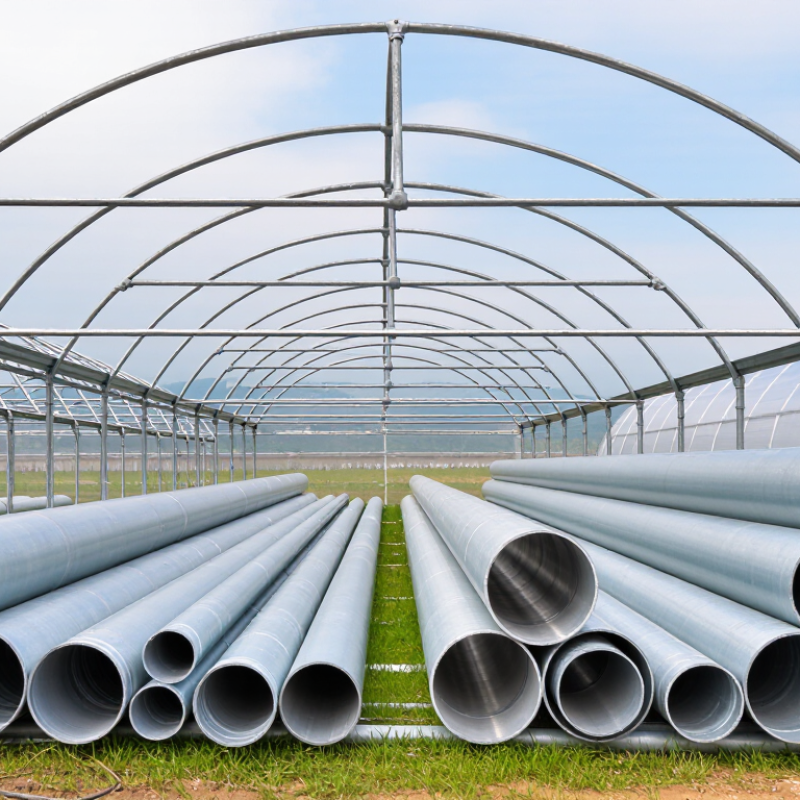
Galvanized greenhouse pipe is steel tubing protected by a zinc coating. The steel gives a frame its strength, while zinc helps slow rust caused by moisture. Inside a greenhouse, condensation can collect on cool pipes, especially near roof joints and shaded corners. Small details matter.
Manufacturing starts with steel strip or a hollow steel section. For welded pipe, the strip is shaped into a tube, and its edges are joined along a seam. The tube is then cut to length and checked for dimensions and weld quality. Galvanizing adds zinc, commonly by dipping the prepared steel in molten zinc or applying a zinc coating through another process. Hot-dip galvanizing can coat both the outer surface and, depending on the process, the interior.
Coating thickness, pipe diameter, wall thickness, and connection design all affect greenhouse use. A thicker coating may improve corrosion resistance, but it does not replace sound drainage or careful assembly. Look for an even finish without bare patches, heavy lumps, or damaged areas around cut ends. Not every pipe suits every frame. I would also check whether fittings match the actual pipe dimensions; a small mismatch can make assembly frustrating.
Best Galvanized Greenhouse Pipe for 2026 Buyers?
How Zinc Coating Protects Greenhouse Pipe from Corrosion
A galvanized greenhouse pipe has a zinc layer that shields steel from moisture and oxygen. If the surface is scratched, nearby zinc can corrode preferentially, helping protect exposed steel. The protection is useful, but not unlimited. Condensation often gathers beneath clamps and inside overlapping joints, where dampness can linger unnoticed.
ISO 9223:2012 classifies atmospheric corrosivity using first-year metal loss. For zinc, its C2 category corresponds to about 0.1–0.7 micrometres of loss per year; C3 corresponds to 0.7–2.1 micrometres. These are exposure categories, not a guaranteed service-life estimate. A coastal site, fertilizer residue, or persistent humidity can make actual conditions harsher than a sheltered inland greenhouse.
Look closely at cut ends, drilled holes, and contact points after assembly. A bright, intact coating should feel continuous; red-brown rust at a joint deserves attention. Avoid trapping wet soil against buried pipe, and rinse deposits from surfaces when practical. Small details matter. Yet zinc coating alone cannot fix poor drainage or constant condensation, and inspection intervals may need adjustment as a structure ages.
Higher coating designations indicate greater total zinc coating mass, which can provide a thicker protective barrier and more sacrificial zinc. Thickness values are approximate estimates assuming an even coating split across both sides and a zinc density of 7.14 g/cm³. ASTM A653 G designations apply to sheet coating; confirm the applicable coating standard and specification for greenhouse pipe. Actual corrosion performance depends on exposure, fabrication, and coating damage.
Best Galvanized Greenhouse Pipe for 2026 Buyers?
For hoops, round galvanized tubing is easy to bend and sheds water cleanly. Common greenhouse frames use roughly 1⅜- to 1⅝-inch outside-diameter tubing, but diameter alone does not determine strength. Wall thickness, hoop spacing, frame height, and local wind or snow loads all matter. A lighter 16-gauge tube may suit a small, sheltered tunnel; exposed sites or wider spans often call for heavier walls or closer supports. Check the load assumptions. Guessing is tempting, but costly.
For straight posts, door frames, and bracing, square or rectangular structural tubing can simplify connections. Look for structural-grade tubing such as ASTM A500, and confirm the supplier’s actual wall thickness and grade documentation. The American Galvanizers Association’s ASTM A123 coating-thickness table specifies a minimum average zinc coating of 85 micrometers for fabricated steel 3–6 millimeters thick, and 100 micrometers above 6 millimeters. These figures concern coating thickness, not frame capacity. Ask whether tubes are galvanized after fabrication; cut ends and drilled holes can otherwise leave vulnerable spots. Small details matter. I would still verify the complete frame against site-specific loads, because a “standard” pipe size is not a structural design.
For a 2026 greenhouse project, compare galvanized pipe by the work it must do, not by price per length alone. Do not shop by diameter alone. Check outside diameter, wall thickness, straightness, and connection fit against the frame design. A pipe that looks sturdy may still flex across a wide bay. Have the planned span, wind exposure, and hanging loads reviewed by a qualified greenhouse or structural professional.
Ask how the pipe was galvanized and whether the coating covers both the inside and outside. Pre-galvanized and hot-dip galvanized options can differ in coating thickness and finish, so request product specifications rather than relying on appearance. Inspect sample ends for bare areas, rough buildup, or damage. Cut ends need suitable protection, especially in damp houses where condensation can collect near joints. I still find this easy to overlook.
Compare tolerances and corrosion protection alongside cost. Slight dimensional variation can make clamps and fittings frustrating to install, even when the pipe is otherwise sound. Confirm that connectors match the stated diameter and wall thickness. Also ask how bundles are packed and stored; wet, tightly wrapped pipe can develop surface staining before installation. Keep the data sheet, coating details, and load assumptions with the project records.
Before buying, match pipe diameter and wall thickness to the greenhouse span, covering weight, and local wind or snow exposure. A tube that looks sturdy in a shop can flex once loaded. Check that lengths are straight, ends are clean, and the zinc coating is even, without bare patches or heavy flakes. Ask for specifications, not just “heavy duty.”
During installation, verify connector fit before assembling the full frame; small mismatches become frustrating at the ridge. Fit matters. Keep cuts square, remove sharp burrs, and protect exposed steel with a suitable zinc-rich repair coating. Avoid trapping water inside open pipe ends; seal or cap them as the design allows. Use compatible fasteners, and avoid scraping the coating with clamps or tools.
Maintenance is modest, but not zero. After storms, inspect joints, base plates, and low points where condensation or soil moisture can linger. Look for white corrosion products, rust, loose bolts, or coating damage. Clean gently and repair small defects early. Long-term value depends on more than purchase price: replacement access, coating quality, and the cost of seasonal checks matter too. I would not treat “galvanized” as a guarantee; site conditions still decide service life.
| What to Check | Practical Buying or Installation Guidance | Why It Matters for Long-Term Value |
|---|---|---|
| Pipe purpose and structural design | Confirm whether each pipe is intended for arches, purlins, posts, or bracing. Select dimensions and spacing from a design that accounts for local wind, snow, and other site loads; there is no universally suitable pipe size. | Greenhouse loads depend on the structure, location, and covering. Correctly sized components help avoid costly deformation or failure. |
| Outside diameter and wall thickness | Check both measurements on the specification, drawing, or product documentation. Common nominal outside diameters include 1 in, 1¼ in, 1½ in, and 2 in, but diameter alone does not establish strength. | Wall thickness, steel grade, unsupported span, and connection details all affect capacity. Comparing only outside diameter can lead to an unsuitable purchase. |
| Galvanizing process and coating specification | Ask whether the pipe is hot-dip galvanized after forming or made from pre-galvanized steel, and request the applicable coating specification or documented coating test results. Compare products using the same measurement method and standard. | Coating coverage and thickness vary with the steel, process, and applicable specification. A clear, verifiable specification makes product comparisons more meaningful than a general “galvanized” description. |
| Surface and coating condition | Inspect delivered pipes for bare areas, peeling, heavy damage, blocked ends, and shipping-related abrasion. Minor appearance variation can occur; assess defects against the supplier’s stated acceptance criteria. | Damaged or incomplete coating can expose steel to moisture and accelerate localized corrosion, particularly in a persistently humid greenhouse. |
| Fit, connectors, and cutting | Verify pipe diameter, connector compatibility, bend radius, and fastening method before ordering. Use suitable cutting tools, deburr cut ends, and protect exposed steel with a compatible zinc-rich repair coating in accordance with its instructions. | Correct fit reduces assembly stress and rework. Cut edges and scratched areas need attention because the original protective coating is no longer intact there. |
| Installation environment | Consider humidity, condensation, irrigation water, fertilizers, cleaning chemicals, and coastal salt exposure. Keep pipes from prolonged contact with corrosive residues, and use compatible isolation materials where dissimilar metals could remain wet together. | Corrosion rates depend strongly on exposure. Salts, persistent moisture, and some chemical residues can shorten coating life compared with a clean, well-ventilated setting. |
| Maintenance routine | Inspect at least annually and after severe weather. Look for coating damage, rust spots, loose connections, trapped debris, and standing water; clean off accumulated soil or chemical deposits and repair damaged areas promptly. | Regular inspection can identify small problems before they spread or affect connections. Inspection frequency may need to increase in coastal, high-humidity, or chemically aggressive conditions. |
| Warranty, traceability, and total cost | Request written details of steel dimensions, coating specification, intended use, warranty exclusions, and replacement availability. Compare delivered cost, installation labor, repair needs, and expected maintenance—not price per length alone. | Service life cannot be reliably guaranteed from the word “galvanized” alone. Documented specifications and realistic maintenance assumptions support a more useful lifecycle-cost comparison. |
Buyer note: Pipe dimensions and coating requirements should be confirmed against the greenhouse design, local building requirements, exposure conditions, and the supplier’s current technical documentation.
It is steel tubing covered with zinc. Steel supports the frame, while zinc slows moisture-related rust. Simple, but useful.
Zinc shields steel from moisture and oxygen. If scratched, nearby zinc may corrode first and help protect exposed steel. The protection is limited.
Check outside diameter, wall thickness, straightness, and connection fit. A pipe that looks sturdy may still flex across a wide bay. Looks can fool you.
Ask how the pipe was galvanized and whether zinc covers the inside and outside. Request specifications; appearance alone can mislead.
Look for bare patches, heavy lumps, and damage around cut ends. Check drilled holes and weld seams, too. Tiny flaws matter.
Yes. Small size differences can make clamps fit poorly. Match connectors to the pipe’s stated diameter and wall thickness. Easy to overlook.
Condensation may linger beneath clamps and inside overlapping joints. Check cut ends, drilled holes, and places where pipe touches wet soil.
No. They describe estimated first-year metal loss, not a guaranteed service life. Coastal air, fertilizer residue, and persistent humidity can worsen conditions.
Ask how bundles are packed and stored. Wet pipe wrapped tightly may develop surface staining. I would not ignore that detail.
Choosing the best Galvanized Greenhouse Pipe for a 2026 project starts with understanding how the pipe is manufactured and how its zinc coating helps resist moisture and corrosion. The coating can support a longer service life, but its effectiveness depends on the pipe’s quality, exposure, and care. Matching diameter, wall thickness, grade, and shape to the greenhouse design is also essential: frame requirements, expected weather loads, and connection methods all influence which option is suitable.
Before buying, compare specifications, coating consistency, dimensions, and overall value rather than relying on price alone. Check that the pipes fit the planned joints and installation method, and inspect cut ends and connections where protective coverage may be disrupted. Routine cleaning and occasional checks for damage can help maintain the frame over time. A well-matched pipe, correctly installed and maintained, can provide a sturdy, practical foundation for a greenhouse project.

Minjie Steel