How to Choose the Right Pre Galvanized Square Tube?

Time:2026-10-03 Author:Liam
0%

Choosing the right Pre Galvanized Square Tube is not simply a matter of picking the lowest price. The tube must match the project’s load, environment, connection method, and expected service life. A polished surface can look convincing. It can still hide poor wall thickness or uneven zinc coverage.

Dr. Wei-Wen Yu, a respected steel-design educator, offers a useful principle: “Design begins with understanding the material, not merely selecting a section.” That idea applies directly to Pre Galvanized Square Tube selection. Buyers should check outside dimensions, wall thickness, steel grade, zinc coating weight, straightness, and tolerance records. Do not rely on appearance alone.

Measure twice.

A tube used for indoor partitions may need different protection than one installed near coastal air, rainwater, or chemical exposure. Consider cutting and welding, too. Factory galvanizing protects the original surface, but exposed edges and weld areas may require suitable repair treatment. Confirm the supplier’s test certificates, production standard, batch traceability, and dimensional inspection process. These documents cannot replace practical judgment, but they make that judgment more reliable.

The difficult part is choosing enough performance without paying for unnecessary material. Sometimes, a heavier tube seems safer. It may also increase handling costs and complicate installation. My own caution is simple: never select a section from a table without checking the real support spacing and connection details. That shortcut feels efficient, but it can produce an unsuitable result. A dependable Pre Galvanized Square Tube is the one that fits the complete application, not just the drawing title.
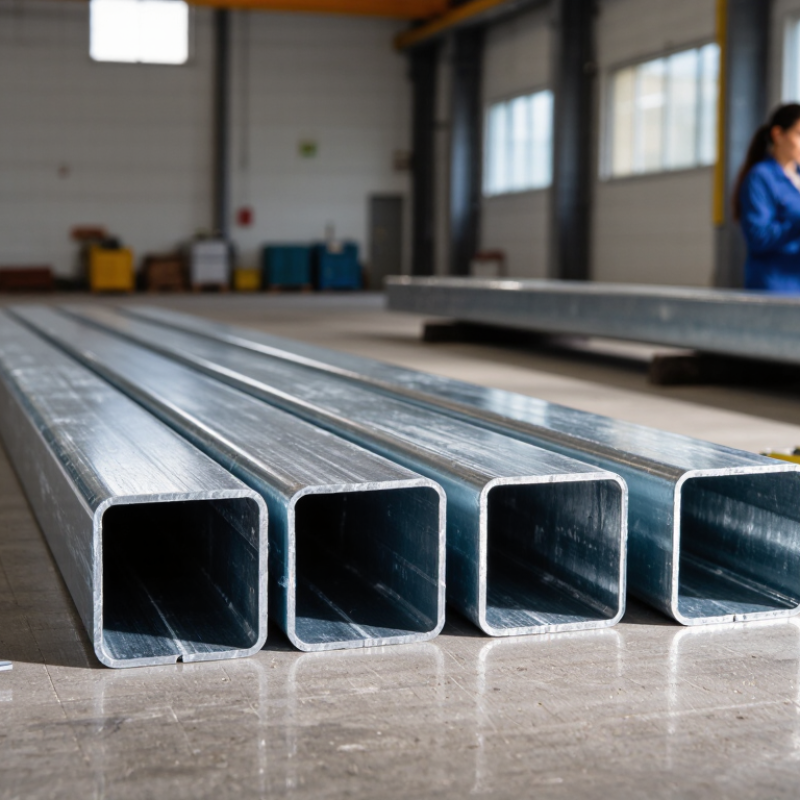
How to Choose the Right Pre Galvanized Square Tube?

Define Pre Galvanized Square Tubes and Their Common Applications

Pre-galvanized square tubes are hollow steel sections formed from galvanized coil. The coil receives a zinc coating before it is shaped and welded. This process protects most surfaces from early rusting. However, the welded seam and freshly cut ends may have thinner or damaged protection. That detail is often missed.

Their applications are practical and varied. Construction consumes roughly half of global steel demand, according to World Steel Association industry data. Pre-galvanized square tubes therefore appear in partition frames, ceiling grids, cable supports, light structural assemblies, fencing, greenhouse frames, and indoor equipment stands. The International Zinc Association reports that galvanizing uses about 60% of global zinc. This reflects zinc’s continuing role in corrosion control.

Choosing the right tube requires more than checking its outside dimensions. Confirm the wall thickness, coating mass, steel grade, weld quality, and allowable load. ASTM A653 coating designations commonly range from about 90 to 275 g/m² total coating mass. Heavier coatings generally offer better protection, but they do not automatically suit every environment. Indoor dry service may need less protection. Coastal, humid, or chemically exposed areas require a careful review of cut edges and weld repairs. I would not assume “galvanized” means maintenance-free. That assumption can fail. When exposed edges cannot be sealed or repaired, hot-dip galvanized tube may be the more reliable choice.

Assess Steel Grade, Dimensions, Wall Thickness, and Tolerance Requirements

How to Choose the Right Pre Galvanized Square Tube?

Steel grade should match the tube’s actual load, forming, and welding needs. ASTM A500/A500M-23 lists Grade B with a minimum yield strength of 46 ksi and Grade C at 50 ksi. That difference matters under repeated loading. Do not accept “mild steel” as a complete specification. Request the mill certificate, heat number, chemical composition, and mechanical results. For corrosion protection, ASTM A653 defines coating designations such as G90, with about 275 g/m² of zinc on both surfaces. This is coating mass, not coating thickness. The NACE IMPACT study estimated global corrosion costs at $2.5 trillion annually, showing why a cheap coating decision can become expensive.

Dimensions need verification at the inspection table, not only on a drawing. For example, a 50 × 50 × 2.0 mm tube should be checked across several points. Under ASTM A500 dimensional guidance, outside dimensions commonly allow ±0.75%, while wall thickness may vary by ±10%. A nominal 2.0 mm wall could therefore approach 1.8 mm before coating. That is significant around bolt holes and welded joints. Check corner radius, straightness, twist, and cut length too. A square tube can look accurate but still rock on a flat bench. I have seen specifications focus on width while ignoring wall variation. That is an avoidable weakness. Record coating condition after cutting, because exposed edges need suitable protection. Tolerance decisions should reflect the real assembly, not an ideal sample.

Compare Zinc Coating Quality, Corrosion Resistance, and Surface Finish

How to Choose the Right Pre Galvanized Square Tube?

When selecting pre galvanized square tube, start with zinc coating quality, not appearance alone. A bright surface can be misleading. I have inspected tubes that looked polished but had uneven coating thickness near corners and weld seams. Use a calibrated coating thickness gauge, and request mill test reports showing coating mass or thickness. Check several points on each tube, because one reading rarely represents the entire surface.

Corrosion resistance depends on the environment and the tube’s handling history. Indoor dry spaces need less protection than coastal, humid, or chemically exposed areas. Zinc protects steel sacrificially, but scratches, cut ends, and drilled holes can become weak points. Look for clean edges and consistent coverage. After fabrication, repair damaged areas with a compatible zinc-rich coating. This step is often forgotten.

Surface finish affects both appearance and performance. A uniform, tightly bonded layer should feel smooth, without flaking, blisters, heavy runs, or dark bare spots. Light surface variation is normal, especially around corners. Excessive roughness is not. Ask how the tube was stored before delivery; trapped moisture between stacked sections can create white corrosion stains. These stains may not mean immediate structural failure, but they deserve inspection. I would also compare samples from different production batches, since quality can vary more than expected. A certificate helps, but physical verification remains necessary.

Select the Right Tube Based on Load, Environment, and Fabrication Needs

How to Choose the Right Pre Galvanized Square Tube?

Selecting a pre galvanized square tube starts with the expected load. Check the tube’s outside dimensions, wall thickness, span, and support spacing. A longer span can increase bending, even when the weight seems modest. Include static loads, movement, vibration, and a practical safety margin. A structural engineer should review critical frames or public-use structures. No single tube fits every job.

Environment matters just as much. Indoor dry areas usually demand less protection than coastal, humid, or chemically exposed locations. Examine the zinc coating and pay attention to welded seams, cut ends, and drilled holes. These areas may need suitable corrosion protection after fabrication. I have seen projects fail early because the surrounding air was underestimated. That mistake is easy to make.

Tips: Match the tube to the actual fabrication process. Confirm whether it will be cut, drilled, bent, or welded. Pre galvanized surfaces can require careful heat control and post-work protection. Measure twice. Use compatible fasteners. Avoid choosing by appearance alone; a heavier tube is not automatically the best value. Request mill certificates, coating details, and dimensional tolerances when traceability matters. A small trial assembly can reveal fit-up problems before full production. Recheck the design when field conditions differ from the original drawings.

Verify Supplier Standards, Testing, Pricing, and Delivery Conditions

Choosing the right pre galvanized square tube starts with supplier verification. Ask for the exact standard, steel grade, outside dimensions, wall thickness, zinc coating mass, and tolerance range. Common references include ASTM A500/A500M for structural tubing and ASTM A653/A653M for galvanized sheet. European projects may require EN 10219 and EN 10346. Request mill certificates with heat numbers, not only a sales quotation. World Steel Association reported approximately 1.89 billion tonnes of crude steel production in 2023, so material origin and traceability deserve careful attention. Large production does not guarantee consistent quality.

Testing should match the application. Check dimensional inspection, tensile strength, weld integrity, coating adhesion, and zinc coating weight. A salt-spray result alone can mislead; laboratory corrosion performance may not represent a humid construction site. I once treated a lower price as better efficiency. It was not. Compare base metal thickness, coating mass, packaging, minimum order quantity, inspection fees, and landed freight. Steel prices can move quickly with raw material and energy costs, as shown in the World Bank Commodity Markets Outlook. Ask how long the quotation remains valid.

Delivery terms need equal attention. Confirm production lead time, loading method, moisture protection, port schedule, Incoterms, and replacement procedures for damaged bundles. Require photographs before shipment and independent inspection when tolerances are critical. A supplier promising “fast delivery” is not enough. Put each condition in writing. Small omissions often become expensive delays.

How to Choose the Right Pre Galvanized Square Tube? - Verify Supplier Standards, Testing, Pricing, and Delivery Conditions
Evaluation Dimension Requirement or Benchmark Standard Construction Tube Higher-Strength Structural Tube Recommended Verification Method
Product Type Pre-galvanized square tube is formed from zinc-coated steel strip before welding and sizing. Suitable for light structural frames, partitions, racks, fencing, and general fabrication. Suitable for load-bearing frames and applications requiring higher yield strength. Confirm that the coating is applied before tube forming and that the product is not hot-dip galvanized after fabrication.
Applicable Product Standard Use a recognized standard that matches the design code and destination market. EN 10219-1 / EN 10219-2 for cold-formed welded structural hollow sections, or an equivalent national standard. ASTM A500/A500M Grade B or Grade C may be used where the project specification requires North American structural tubing. Request the exact standard edition, grade designation, and compliance statement on the mill test certificate.
Steel Grade Grade selection should be based on yield strength, tensile strength, weldability, and design calculations. S235-class structural steel, typically with a minimum yield strength around 235 MPa, depending on the applicable standard and thickness. S355-class steel or ASTM Grade C, commonly offering a yield strength around 355 MPa or 50 ksi respectively, subject to thickness limits. Compare the certificate values with the specified standard rather than relying only on a product catalog.
Common Square Sizes Dimensions must suit the required load, connection detail, and available fabrication equipment. 20 × 20 mm to 100 × 100 mm are common for general fabrication; larger sizes are available from some mills. 60 × 60 mm to 200 × 200 mm are commonly selected for heavier frames, with wall thickness chosen by calculation. Check outside dimensions, corner radius, straightness, and wall-thickness tolerance against the stated standard.
Wall Thickness Typical commercial ranges must be confirmed because minimum thickness affects strength and corrosion life. Approximately 0.8–3.0 mm for light and medium fabrication applications. Approximately 3.0–8.0 mm for structural applications, subject to available production capability. Specify both nominal and minimum permissible thickness; verify with calibrated ultrasonic or micrometer measurements.
Zinc Coating Grade Coating mass should be defined in grams per square metre or as an equivalent coating designation. Common pre-galvanized coating ranges are approximately 60–275 g/m² total, depending on coil grade and surface requirement. For more demanding exposure, request the highest practical coating class available for the selected thickness and forming process. Confirm whether the stated value is total coating mass on both surfaces or coating mass per surface; these values are not interchangeable.
Zinc Coating Appearance The surface should be continuous and free from defects that impair service or fabrication. Uniform metallic appearance with limited discoloration, minor handling marks, and no exposed bare steel on the main surface. More consistent surface control is preferred where the tube will remain visible after installation. Inspect sample bundles for bare spots, peeling, excessive white rust, deep scratches, and damaged weld zones.
Weld Seam Quality The longitudinal weld must provide adequate continuity and dimensional integrity. Continuous high-frequency welded seam with the external weld bead removed or controlled according to the product standard. Controlled weld profile and documented process parameters are preferred for structural and fatigue-sensitive applications. Request visual inspection records and, where required, eddy-current, ultrasonic, or other non-destructive weld testing.
Mechanical Testing Mechanical properties must be traceable to the heat or production batch. Tensile testing is normally used to verify yield strength, tensile strength, and elongation. Tensile testing plus additional verification of impact properties may be required for low-temperature or critical structures. Check that the mill test certificate identifies heat number, grade, thickness, test results, and applicable standard.
Dimensional Tolerances Accurate dimensions reduce fit-up problems and fabrication waste. Typical requirements include outside-dimension, wall-thickness, length, straightness, and corner-radius tolerances. Tighter dimensional control is recommended for automated cutting, robotic welding, and precision assemblies. Measure samples from different bundles, not only one piece from the top of a shipment.
Corrosion Environment Pre-galvanized tube is not automatically suitable for every exposure category. Appropriate for indoor, dry, or moderately sheltered environments when the zinc coating remains intact. For coastal, industrial, or continuously wet exposure, consider a heavier coating, post-fabrication galvanizing, or a duplex paint system. Compare the expected service environment with ISO 12944 or the project corrosion specification.
Cut-End Protection Cut ends expose uncoated steel and can become early corrosion points. Use zinc-rich repair paint or an approved corrosion-protection compound after cutting and drilling. For severe exposure, seal or protect all cut edges and weld areas according to the coating system specification. Confirm whether end protection is included in the supplier’s scope or must be completed by the fabricator.
Quality Documentation Documents should support traceability from order to delivered bundle. Mill test certificate, dimensional inspection report, packing list, and certificate of conformity. Mill certificate plus coating test results, weld inspection records, and independent inspection when required by contract. Require documents before shipment or as a contractual release condition, with heat and bundle numbers matching the labels.
Indicative Price Level Pricing varies with steel market conditions, size, thickness, coating mass, order quantity, and destination. Approximately USD 850–1,150 per metric ton for common sizes and moderate coating levels, excluding taxes and freight. Approximately USD 950–1,350 per metric ton for higher-strength grades, heavier walls, or enhanced inspection requirements. Request a quote based on exact size, wall thickness, grade, coating mass, length, quantity, packing, and delivery term.
Price Adjustment Terms Long lead-time orders can be affected by steel and zinc price changes. Fixed pricing is generally easier for short production cycles and confirmed raw-material allocations. For large or scheduled releases, a documented adjustment formula may be used for steel, zinc, and freight changes. Define the quotation validity period, adjustment index, currency, payment milestones, and tax treatment.
Minimum Order Quantity Small orders may carry cutting, setup, and packing surcharges. Typical mill or distributor quantities may range from 5–25 metric tons, depending on size and stock availability. Custom grades, unusual sizes, and special coating requirements may require 20 metric tons or more. Ask for the minimum quantity per size, grade, thickness, and production lot before finalizing the purchase order.
Standard Length Length affects cutting loss, handling, transport, and fabrication efficiency. 6 m and 12 m are common standard lengths; other fixed lengths may be available by agreement. Custom cut lengths may require a tolerance allowance and additional processing charge. Confirm actual length tolerance, bundled length mix, and whether random lengths are acceptable.
Production Lead Time Lead time should include raw-material preparation, forming, testing, packing, and dispatch. Obtain a production schedule with inspection date, document-release date, and estimated cargo-ready date.
Stock Availability Stock products can shorten delivery but may limit grade, thickness, coating, and length choices. Common sizes may be available from regional stockholders with dispatch in approximately 3–10 working days. Special structural grades and uncommon dimensions are more likely to be made to order. Request current stock photos, bundle labels, manufacturing date, and inspection records rather than relying on inventory claims alone.
Packing and Handling Packaging must prevent deformation, abrasion, and prolonged moisture retention during transport. Steel strapping with bundle labels, separators, and weather-resistant wrapping is commonly used. Use reinforced bundles and additional edge protection for heavy sections or long-distance transport. Specify bundle weight, lifting points, label content, wrapping method, and protection against seawater exposure.
Delivery Terms Incoterms determine which party controls freight, insurance, export clearance, and delivery risk. EXW or FCA may suit buyers with their own freight arrangements. FOB, CFR, or CIF may be preferred when the supplier arranges export shipment and ocean freight. State the Incoterms rule and named place or port, cargo insurance responsibility, and transfer-of-risk point.
Transit Time Transit time must be separated from factory production time. Domestic or regional delivery commonly takes 2–10 working days after dispatch. International sea freight may take approximately 20–45 days port to port, excluding customs and inland delivery. Request a complete timeline covering production, inspection, port handling, ocean freight, customs, and final delivery.
Supplier Approval Decision Select the supplier that provides the best verified combination of compliance, consistency, cost, and delivery reliability. Recommended when the project uses standard sizes, moderate exposure, and routine inspection requirements. Recommended when structural calculations, higher strength, critical welds, or enhanced traceability are required.

FAQS

How can I verify the zinc coating quality of a pre galvanized square tube?

Use a calibrated coating thickness gauge at several points. Check corners, flat faces, and welded seams. One reading is not enough. Request mill certificates showing coating mass or thickness. A bright surface can still hide uneven coverage.

Does a shiny surface prove good tube quality?

No, appearance alone can mislead. The coating should feel smooth and tightly bonded. Avoid flaking, blisters, heavy runs, or dark bare spots. Small variations near corners are normal. I once trusted a polished surface. That judgment was wrong.

Which environments require stronger corrosion protection?

Coastal, humid, and chemically exposed areas need closer inspection. Dry indoor spaces are usually less demanding. Scratches, drilled holes, and cut ends can become weak points. Apply a compatible zinc-rich repair coating after fabrication. This step is often forgotten.

What load information should guide tube selection?

Check outside dimensions, wall thickness, span, and support spacing. Include static loads, movement, vibration, and a practical safety margin. Longer spans can increase bending unexpectedly. A heavier tube is not automatically better value. Critical structures need professional engineering review.

How do fabrication processes affect pre galvanized square tubes?

Confirm whether the tube will be cut, drilled, bent, or welded. Heat can damage nearby zinc protection. Protect exposed areas after fabrication. Use compatible fasteners. Measure twice.

What supplier documents should I request?

Ask for the steel grade, dimensions, wall thickness, coating mass, and tolerances. Request mill certificates with heat numbers. Check dimensional inspection and tensile results when appropriate. Weld integrity and coating adhesion may also require verification. A quotation alone provides limited traceability.

How should I compare tube prices fairly?

Compare base metal thickness, coating mass, packaging, order quantity, inspection fees, and freight. A low unit price may hide additional costs. Steel and energy prices can change quickly. Ask how long the quotation remains valid. I once chose the cheapest option. It was not efficient.

What delivery details deserve written confirmation?

Confirm production time, loading methods, moisture protection, port schedules, and replacement procedures. Ask for shipment photographs before loading. Independent inspection helps when tolerances are critical. Moisture trapped between stacked tubes can create white corrosion stains. Those stains need inspection, but they do not always indicate immediate failure.

Conclusion

Choosing the right Pre Galvanized Square Tube starts with understanding its structure, manufacturing process, and typical uses in construction, fencing, framing, furniture, and light industrial projects. Evaluate the steel grade, outside dimensions, wall thickness, length, and dimensional tolerances to ensure the tube meets both design and installation requirements. The selected specifications should provide adequate strength without creating unnecessary weight or cost.

Zinc coating quality is equally important because it affects corrosion resistance, appearance, and service life. Consider coating consistency, surface finish, adhesion, and protection requirements for the intended environment. For reliable performance, match the tube to expected loads, exposure conditions, cutting, welding, drilling, and other fabrication needs. Before purchasing, verify the supplier’s material standards, inspection records, testing procedures, packaging, pricing, minimum order quantity, lead time, and delivery terms. A careful comparison of these factors helps ensure the Pre Galvanized Square Tube is safe, durable, practical, and suitable for the project.


Liam

Liam

Liam is a dedicated marketing professional with a profound expertise in the industry, where he excels at highlighting the unique advantages of our core products. With a keen understanding of market trends and consumer needs, Liam frequently updates our company’s professional blog, providing......