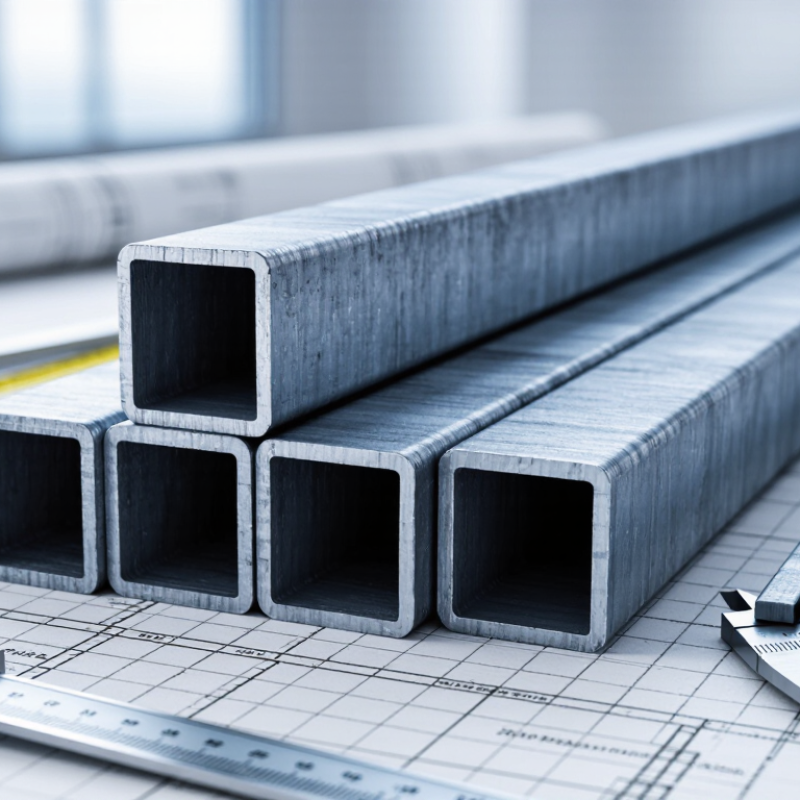
| 1. Structural Purpose |
Identify how the square hollow section will be used. |
Columns, beams, bracing members, frames, guardrails, machine supports, vehicle structures, or architectural elements. |
Select the section according to the dominant action: compression for columns, bending for beams, tension or compression for bracing, and combined loading for frames. |
| 2. Applied Loads |
Determine all permanent, temporary, impact, wind, snow, seismic, and equipment loads. |
Include axial force, bending moment, shear force, torsion, load duration, and load combinations required by the applicable design code. |
Do not select a tube from outside dimensions alone. Check cross-sectional resistance, buckling, deflection, vibration, and connection forces. |
| 3. Span and Support Conditions |
Define the unsupported length and how the member is supported. |
Common conditions include simply supported, fixed-ended, braced, cantilevered, and continuously restrained members. |
Longer unbraced lengths increase lateral and flexural buckling risk. Improve restraint or select a larger section with a higher radius of gyration. |
| 4. Outside Dimensions |
Confirm the available space and required clearance. |
Common nominal SHS sizes include 50 × 50 mm, 100 × 100 mm, 150 × 150 mm, and 200 × 200 mm. |
Use a larger outside dimension when greater stiffness is needed and space permits. A larger depth generally improves bending stiffness more efficiently than simply increasing wall thickness. |
| 5. Wall Thickness |
Define the required resistance, local buckling performance, durability, and connection capacity. |
Typical structural wall thicknesses range from approximately 3 mm to 12.5 mm, depending on section size and design standard. |
Increase wall thickness for high compression, concentrated loads, welded connections, impact exposure, or reduced local slenderness. Check minimum thickness after corrosion allowance. |
| 6. Section Classification |
Check whether the flat width-to-thickness ratio is suitable for the intended stress level. |
Classification limits depend on the design code, steel grade, stress distribution, and internal or external compression. |
Use the applicable standard, such as EN 1993-1-1, AISC 360, or another governing code, to determine whether the section is compact, non-compact, or slender. |
| 7. Steel Grade |
Specify the required yield strength, tensile strength, weldability, and toughness. |
Common structural grades include S235 and S355 under European practice. Equivalent grades must be verified rather than assumed. |
Use a higher-strength grade only when it provides a verified design benefit. Stiffness is controlled mainly by geometry and elastic modulus, not yield strength. |
| 8. Corrosion and Service Environment |
Assess moisture, salt, chemicals, temperature, abrasion, and exposure conditions. |
Interior dry exposure, exterior exposure, coastal exposure, industrial atmosphere, buried service, and high-humidity environments require different protection levels. |
Consider hot-dip galvanizing, a compatible coating system, stainless steel, sealed hollow sections, drainage details, and a calculated corrosion allowance where appropriate. |
| 9. Fire Requirements |
Determine whether the member must maintain resistance during a fire exposure period. |
Fire resistance may be specified by time, such as 30, 60, or 90 minutes, depending on the building code and occupancy. |
Check the reduced material properties and section factor. Fire protection may include board systems, spray protection, intumescent coating, or concrete filling. |
| 10. Connections and Fabrication |
Define how the tube will be joined and fabricated. |
Possible connections include fillet welds, groove welds, bolted end plates, gusset plates, cleats, base plates, and mechanical fittings. |
Verify local wall yielding, punching, crippling, weld access, bolt clearance, end-plate stiffness, and load transfer through the hollow section wall. |
| 11. Tolerance and Surface Finish |
Confirm dimensional tolerances and finish requirements. |
Check outside dimensions, wall thickness, straightness, corner radius, squareness, length tolerance, and surface condition against the purchasing standard. |
Use the relevant product standard, such as EN 10210 for hot-finished sections or EN 10219 for cold-formed welded sections, when applicable. |
| 12. Verification Before Purchase |
Confirm that the selected section satisfies both structural and project requirements. |
Required documents may include a material certificate, dimensional inspection, weld-quality records, coating information, and traceability details. |
Obtain a design check from a qualified engineer for load-bearing applications. Published section properties are not a substitute for a project-specific calculation. |
 Minjie Steel